
Why everyone is talking about LLMs
Over the last few years, Large Language Models (LLMs) have changed how millions of people interact with computers. They write code, summarize documents, explain scientific papers, translate languages, answer questions, and increasingly act as the reasoning engine behind modern AI assistants.
At first glance, these systems seem almost magical.
How can a model write software, solve calculus, explain quantum physics, and draft legal documents?
The answer is surprisingly simple:
Modern LLMs are not databases, search engines, or collections of handwritten rules. They are enormous neural networks trained to predict the next token in a sequence.
Everything else emerges from that objective.
The two things every LLM needs
An LLM can be thought of as two components:
+-------------------------+ | Model Weights | | Billions of parameters | +------------+------------+ | v +-------------------------+ | Runtime / Inference | | Transformer execution | +------------+------------+ | v Generated TextThe first component is a large collection of learned numerical parameters.
The second is software that knows how to execute the Transformer architecture using those parameters.
Without the runtime, the parameters are meaningless.
Without the parameters, the runtime produces nothing useful.
Together they form an LLM.
Parameters are learned knowledge - not stored documents
One of the biggest misconceptions is that LLMs “compress the internet.”
This is a useful analogy, but it shouldn’t be taken literally.
During training, the model does not store web pages inside its weights.
Instead, gradient descent gradually adjusts billions of numerical parameters so that the model becomes better at predicting the next token.
A better mental model is:
- A search engine retrieves documents.
- A database stores records.
- An LLM learns statistical relationships between concepts.
Knowledge is distributed across millions or billions of parameters rather than stored in one location.
Training vs inference
Training and inference are fundamentally different phases.
Training
Training is expensive.
It may require:
- trillions of tokens
- thousands of GPUs
- weeks of computation
- enormous electricity costs
The model repeatedly predicts the next token, measures how wrong it was, computes gradients, and slightly adjusts its parameters.
Over billions of updates, patterns begin to emerge.
Inference
Inference is what happens after training.
When you ask a question:
- Your text is tokenized.
- Tokens become vectors.
- They pass through Transformer blocks.
- The model predicts the next token.
- That token is appended.
- The process repeats.
No learning happens during inference.
The deployed model is not rewriting its own weights while chatting.
Tokens: how language becomes numbers
Computers don’t understand words.
They understand numbers.
A tokenizer converts text into smaller pieces called tokens.
"Artificial Intelligence is amazing."
    ↓
["Artificial", " Intelligence", " is", " amazing", "."]
Each token receives a unique integer ID.
Artificial → 18472 Intelligence → 9211 is → 318 amazing → 8301
These IDs are then converted into dense vectors called embeddings.
Embeddings
Embeddings are learned numerical representations.
Instead of representing a word as a single integer, the model represents it as a high-dimensional vector.
Words with similar meanings tend to occupy nearby regions of this vector space.
This allows the model to generalize far beyond memorization.
Why Transformers changed everything
Before Transformers, language models relied on recurrent neural networks (RNNs) and LSTMs.
These processed words one at a time, making it difficult to capture long-range dependencies and limiting parallelization.
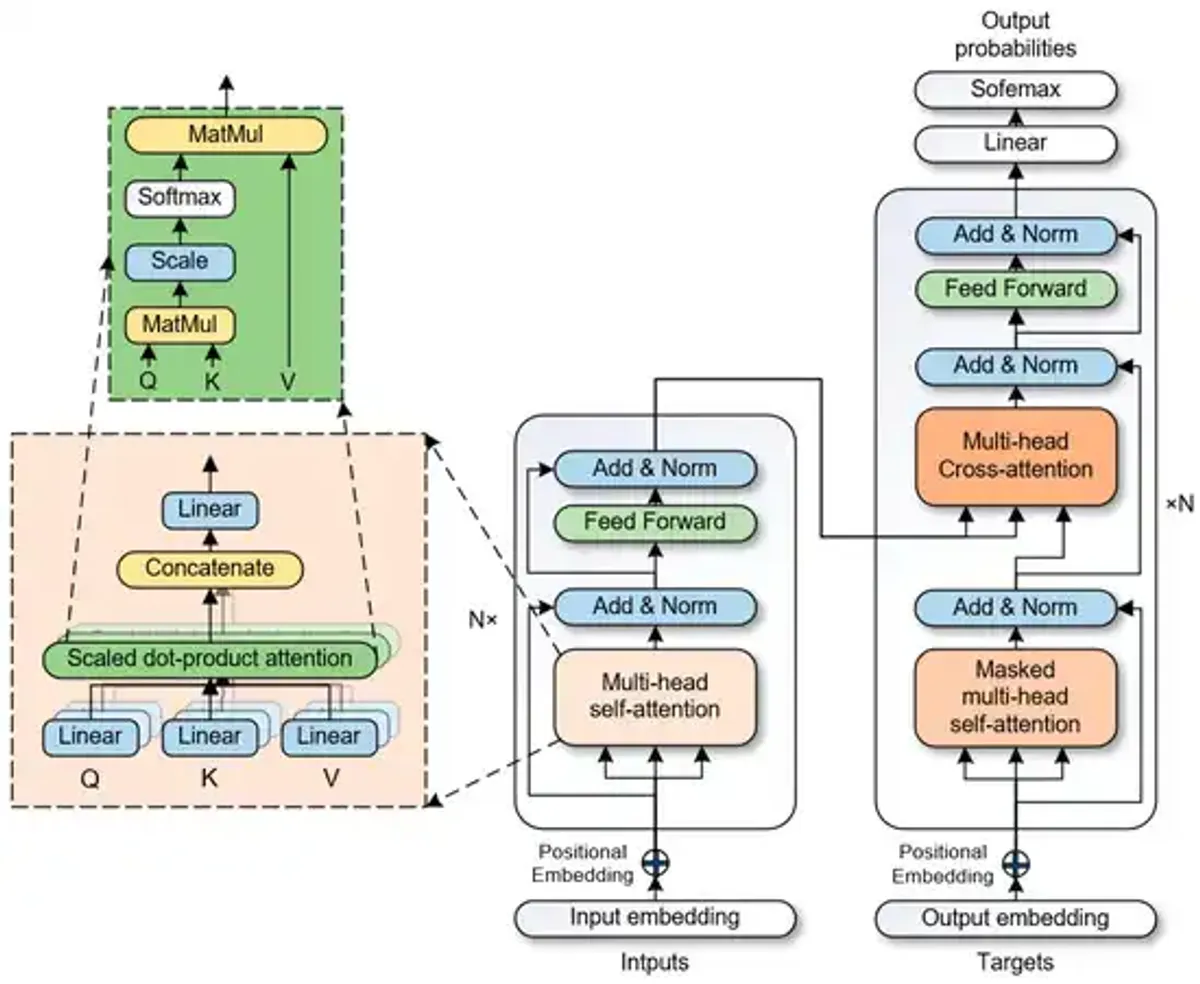
Transformers introduced self-attention, allowing every token to attend to every other relevant token simultaneously.
This dramatically improved both quality and training efficiency.
Self-attention
Suppose we have the sentence:
“The animal didn’t cross the road because it was tired.”
What does it refer to?
Humans immediately know it refers to the animal.
Self-attention allows the model to discover this relationship by comparing every token with every other token.
Rather than reading sequentially, the model asks:
- Which previous words matter most?
- How strongly should they influence this token?
That ability to dynamically focus on relevant context is one of the biggest reasons Transformers work so well.
Positional information
Because Transformers process tokens in parallel, they also need to know the order of words.
Position information is added to token embeddings so the model can distinguish:
Dog bites man
from
Man bites dog
The same words, different meaning.
Transformer block
A simplified Transformer block looks like:
Input | Embeddings | Self Attention | Add & Normalize | Feed Forward Network | Add & Normalize | Output
Modern LLMs stack dozens or even hundreds of these blocks.
Each layer gradually builds richer representations of language.
Why next-token prediction works
At first, predicting the next token seems far too simple.
Yet consider the sentence:
“The capital of France is ____”
To predict the missing token, the model must understand:
- geography
- language
- grammar
- factual associations
Across trillions of training examples, this objective forces the network to develop sophisticated internal representations.
It isn’t explicitly taught grammar rules or world knowledge.
Those emerge from optimization.
From Prompt to Prediction
Imagine you ask:
Why is the sky blue?A modern LLM performs roughly the following steps:
User Prompt │ ▼ Tokenization │ ▼ Token Embeddings │ ▼ Positional Information │ ▼ Transformer Layers │ ▼ Final Hidden State │ ▼ Probability Distribution │ ▼ Token Selection │ ▼ Append Token │ ▼ RepeatAlthough the model appears to “write sentences,” internally it is only predicting one token at a time.
Step 1: Tokenization
Before computation begins, text is broken into tokens. These are not always complete words. Frequent words may be a single token, while uncommon words are split into smaller pieces.
This allows a model to understand virtually any text without storing every possible word in its vocabulary.
Step 2: Embeddings
Every token ID is mapped to a high-dimensional vector called an embedding.
Instead of saying:
Paris = 13872the model represents Paris as hundreds or thousands of floating-point numbers.
Similar concepts tend to occupy nearby regions of the embedding space, allowing the model to generalize beyond memorization.
Step 3: Attention Across Context
Each Transformer layer allows tokens to exchange information.
When processing:
“The Eiffel Tower is located in Paris.”
the representation of “Paris” influences “Tower,” while “Tower” also influences “Paris.”
Every layer refines this contextual understanding.
Rather than remembering individual facts, the network continuously updates representations based on surrounding context.
Step 4: Producing Probabilities
After the final Transformer layer, the model produces a probability for every token in its vocabulary.
Example:
sky 0.42cloud 0.18ocean 0.07blue 0.25...The model does not immediately output the highest value. Instead, a decoding strategy determines which token will be generated.
Decoding Strategies
Greedy Decoding
The simplest strategy always chooses the most probable token.
Advantages:
- deterministic
- predictable
- fast
Disadvantages:
- repetitive
- less creative
- can become trapped in repetitive loops
Temperature
Temperature controls randomness.
Lower temperatures make the model conservative.
Higher temperatures encourage exploration.
Temperature = 0.2→ More factual
Temperature = 1.0→ Balanced
Temperature = 1.5→ More creative
Temperature does not increase intelligence---it only changes how probabilities are sampled.
Top-k Sampling
Instead of considering every token, the model keeps only the k most probable candidates.
Example:
Top 5 tokens
bluegrayclearbrightwhite
The final token is sampled only from these candidates.
Top-p (Nucleus Sampling)
Rather than selecting a fixed number of candidates, Top-p keeps adding tokens until their cumulative probability exceeds a threshold.
This often produces more natural text than Top-k because the number of candidate tokens changes depending on the confidence of the model.
Why Responses Differ
Many users ask:
“Why did the model answer differently even though I asked the same question?”
The answer is simple.
If randomness is enabled through temperature or sampling, multiple valid continuations may exist.
The model is generating---not retrieving---a response.
Hallucinations Begin Here
Because the model predicts statistically plausible continuations instead of verifying facts, it may confidently generate information that sounds correct but is false.
Hallucinations are not bugs in the traditional sense.
They are a consequence of a generative objective.
Modern AI assistants reduce hallucinations by combining LLMs with:
- retrieval systems (RAG)
- web search
- calculators
- code execution
- external databases
These systems help ground answers in verifiable information rather than relying solely on the model’s internal representations.
Why Bigger Models Perform Better
One of the biggest discoveries in modern AI is that performance often improves predictably as three quantities increase together:
- Model parameters
- Training data
- Compute
These observations are known as scaling laws.
The key insight is not simply “bigger is better.” Instead, models perform best when size, data, and compute grow in balance.
Tiny model + huge dataset❌ Underpowered
Huge model + tiny dataset❌ Undertrained
Balanced growth✅ Best performance
Scaling laws helped researchers estimate how capable a model might become before spending millions of dollars training it.
Important: Scaling laws are empirical observations, not guarantees. Researchers continue to study where diminishing returns may eventually appear.
Context Windows
An LLM does not remember every conversation forever.
Instead, it only processes a fixed amount of recent information called its context window.
Examples include:
- 8K tokens
- 32K tokens
- 128K tokens
- 1M+ tokens (some modern systems)
Think of the context window as the model’s working memory.
Conversation───────────────────────────────────────▶
[ Old Messages ][ Current Context ]       ✗               ✓
When the conversation exceeds the available context, older information may be truncated or summarized.
This is one reason AI assistants sometimes forget details from long conversations.
Mixture of Experts (MoE)
Many modern models are no longer dense neural networks.
Instead, they use a Mixture of Experts (MoE) architecture.
Imagine a hospital.
Instead of asking every doctor to examine every patient, a receptionist sends each patient to the most appropriate specialist.
MoE works similarly.
Input Token │ ▼ Routing Network │ ┌────┴────┐ ▼ ▼Expert A Expert B ...Only a subset of expert networks is activated for each token.
Benefits include:
- Larger total parameter counts
- Lower inference cost
- Better specialization
A model may contain hundreds of billions of parameters while activating only a fraction for any individual token.
Quantization
Training typically uses high-precision numbers such as FP16 or BF16.
Inference, however, often uses lower precision.
Examples:
Format Typical Use
FP32 Research and training FP16 / BF16 Modern training and inference INT8 Efficient deployment INT4 Consumer hardware
Reducing precision decreases memory usage and often increases inference speed.
The trade-off is a small reduction in numerical precision, though modern quantization techniques preserve surprisingly high quality.
This is one reason large open-source models can run on consumer GPUs and even high-end laptops.
KV Cache
A common question is:
Why is the first generated token slower than the rest?
The answer is the Key-Value (KV) Cache.
Without caching, every new token would require recomputing attention over the entire conversation.
Instead, previous attention computations are stored.
Prompt │ ▼Attention │ ▼Store KV Cache │ ▼Reuse for Future TokensInstead of repeating expensive work, the model reuses cached attention information.
Benefits:
- Lower latency
- Faster token generation
- Reduced computation
This optimization is one of the reasons streamed responses appear increasingly fast after the first few tokens.
Putting It Together
Modern frontier models are not defined by a single breakthrough.
They combine multiple engineering innovations:
- Transformer architectures
- Scaling laws
- Larger context windows
- Mixture of Experts
- Quantization
- KV caching
Each idea contributes to making today’s AI systems more capable, efficient, and practical to deploy.
Retrieval-Augmented Generation (RAG)
One limitation of every pretrained LLM is that its knowledge is bounded by its training data. Retraining a model every time documentation changes would be impractical.
Retrieval-Augmented Generation (RAG) solves this problem by allowing the model to retrieve relevant information at inference time.
User Question │ ▼Vector Search │ ▼Relevant Documents │ ▼LLM + Retrieved Context │ ▼Grounded AnswerRather than relying only on internal knowledge, the model receives fresh information as part of its prompt.
When should you use RAG?
RAG is ideal when information changes frequently, such as:
- company documentation
- product manuals
- legal policies
- support knowledge bases
- research papers
In many production systems, RAG is preferred over fine-tuning because it keeps answers up to date without retraining the model.
Fine-Tuning vs RAG
Although they are often mentioned together, they solve different problems.
  ---------------------------------------------------------------------------------------------  Fine-Tuning                                          RAG  ---------------------------------------------------- -------------------------------------------  Changes model behavior                               Supplies external knowledge
  Requires additional training                         No retraining required
  Best for style or domain adaptation                  Best for frequently changing information  ------------------------------------------------------------------------------------------------
Many successful AI applications use both approaches together.
Tool Calling
An LLM is excellent at reasoning over text, but it cannot magically perform actions on its own.
Instead, modern AI assistants connect models to external tools.
Examples include:
- web search
- calculators
- Python execution
- SQL databases
- calendars
- internal company APIs
A typical workflow looks like this:
User │ ▼LLM decides a tool is needed │ ▼Tool executes │ ▼Result returned │ ▼LLM explains the resultThis is why some AI assistants can answer questions about today’s weather or perform calculations, even though the underlying language model was trained months earlier.
Multimodal Models
Early language models only accepted text.
Modern foundation models increasingly support multiple modalities.
These may include:
- text
- images
- audio
- video
For example, an assistant can:
- explain a chart
- transcribe speech
- summarize a meeting
- answer questions about an uploaded image
The underlying system still relies on learned representations---it simply extends them beyond text.
AI Assistants, Agents, and Workflows
These terms are often used interchangeably, but they describe different ideas.
LLM
A neural network that predicts the next token.
AI Assistant
An LLM wrapped with tools, memory, safety systems, and a user interface.
Workflow
A predefined sequence of steps combining one or more models and external services.
AI Agent
A system that can plan, choose actions, call tools, evaluate intermediate results, and continue working toward a goal with limited human intervention.
An agent is not a more intelligent LLM. It is an architecture built around one or more LLMs.
Security Challenges
As LLMs become integrated into products, security becomes critical.
Prompt Injection
Prompt injection attempts to manipulate the model through malicious instructions embedded in user input or retrieved documents.
A secure system should separate trusted instructions from untrusted data and validate outputs before taking action.
Jailbreaking
Jailbreaking attempts to bypass safety constraints using carefully crafted prompts.
Model developers continuously improve defenses, but this remains an active area of research.
Tool Abuse
Giving an LLM access to external tools introduces additional risks.
For example, a compromised prompt should not be able to send emails, execute arbitrary code, or access confidential data without proper authorization.
The safest systems rely on multiple layers of validation rather than trusting every model output.
Hallucinations and Limitations
LLMs remain probabilistic generators.
They can:
- misunderstand ambiguous prompts
- produce incorrect facts
- invent citations
- make reasoning mistakes
- struggle with highly specialized or unseen information
Hallucinations do not necessarily disappear as models become larger. Instead, developers reduce them through better training, retrieval, verification, and evaluation.
Where the Field Is Heading
Progress in AI is likely to come from improvements across the entire system rather than a single breakthrough.
Areas of active development include:
- better reasoning
- longer context windows
- faster inference
- more efficient architectures
- stronger safety mechanisms
- improved multimodal understanding
- better evaluation methods
While capabilities continue to improve, it’s important to distinguish established techniques from ongoing research. Not every experimental result becomes a production feature.
Final Thoughts
Large Language Models may seem mysterious, but the core idea is remarkably simple.
A model learns statistical patterns from enormous amounts of data and uses those patterns to predict the next token.
Around that foundation, engineers build increasingly sophisticated systems:
- retrieval
- tool calling
- memory
- orchestration
- safety
- evaluation
Together, these components transform a next-token predictor into an AI assistant capable of solving useful real-world tasks.
Understanding the distinction between the model and the system is one of the most important concepts in modern AI. The future of intelligent software will be shaped not only by larger models, but by better engineering around them.